VFX vs AI Video: What a Dragon Shot Teaches Brands


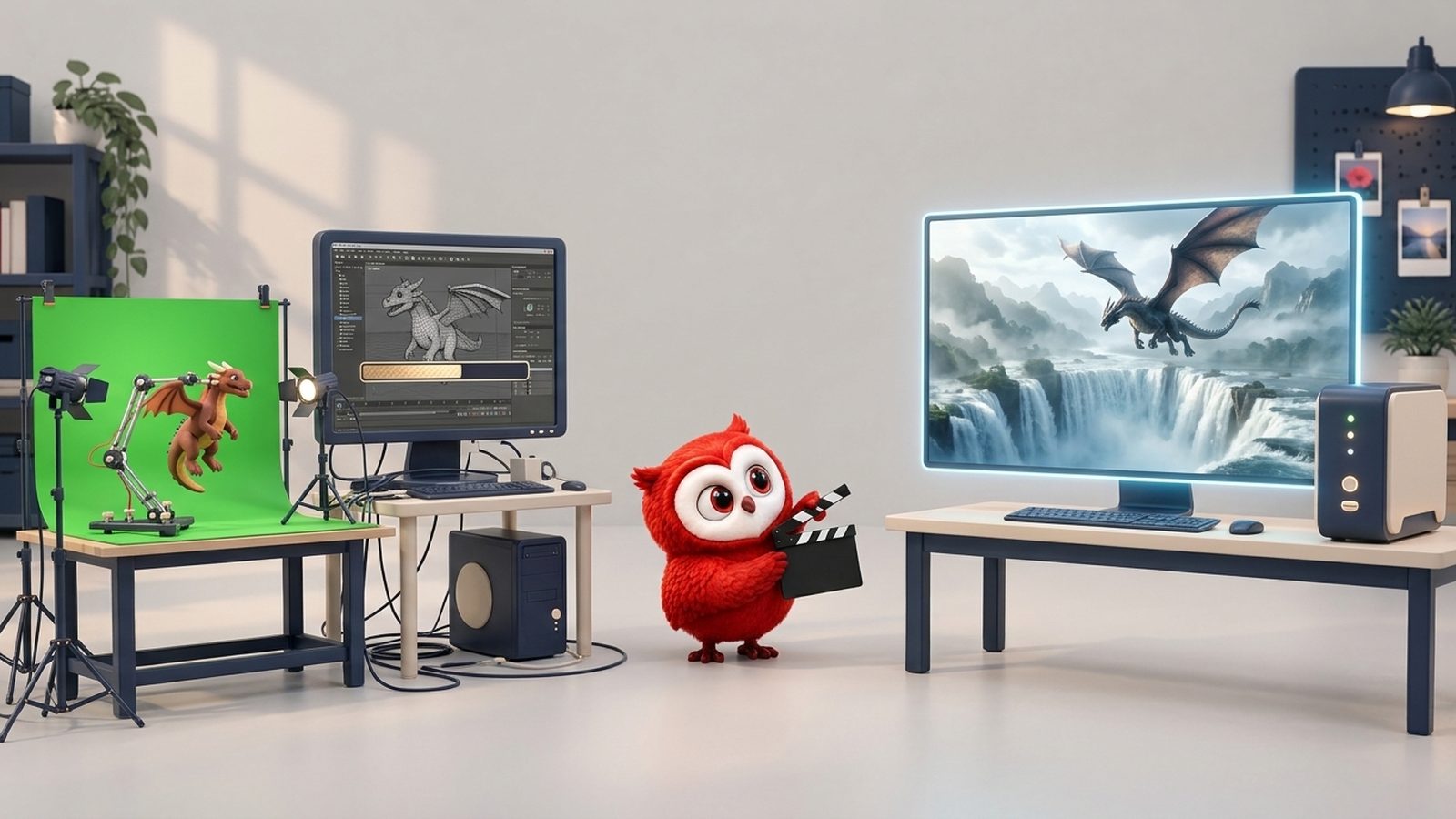
A VFX artist built the same dragon shot twice: once the traditional way, once with an AI video model. Erik of the YouTube channel ErikDoesVFX published the experiment as “Did AI Just Change Movies Forever?” (7 August 2026, about 17 minutes, more than 8 million views by late October). It is the clearest public side-by-side we have seen of a classic VFX pipeline and generative video. Here is what it shows, and what we think it means for brands that buy video.
What the video does
The chapters tell the story. Erik films a real plate, then builds a dragon and a waterfall shot with a conventional 3D and compositing workflow: a purchased 3D dragon model, water simulation, the reverse shot, the dragon interacting with the waterfall, and a whole chapter on why rendering takes so long. Then he recreates the shots with AI, has the dragon take flight in both versions, reacts to each, and closes with “the best version”.
The description says everything AI in the video was generated with Seedance 2.5 on Higgsfield, and links to Higgsfield. Keep that in mind: it is a showcase made with the platform, not a neutral benchmark. We recommend watching it yourself rather than taking anyone’s verdict, including ours.
The real question is not “AI or VFX”
For a brand, the useful question is which tool fits which job. The two approaches trade different things:
- Traditional VFX buys control. Every frame can be adjusted, the product looks exactly right, and the shot can be reproduced next month. The price is time: modelling, simulation, rendering and compositing are slow, which is why the video spends a whole chapter on render times.
- AI video buys speed and range. A model like Seedance 2.5 turns a reference image and a prompt into a moving shot in minutes, including shots that would be unaffordable to build by hand. The price is control: details drift, and getting the same result twice takes work.
Erik’s experiment starts from footage he actually filmed. That is the pattern we see working for clients too: shoot what must be real, generate what would be too expensive to build.
Where AI video already pays off for brands
- Concepts and animatics: show a client or a board the idea in motion before anyone books a crew.
- Social variations: one campaign idea, many short cuts and formats for Reels, TikTok and ads.
- The impossible shot: a dragon, a flying camera over a city, a product in a world you cannot rent.
- Extending real footage: new backgrounds, transitions and openings around a real shoot.
Where we still shoot or build it properly
- The product itself: labels, logos, packaging and proportions must be exact. AI models still reinterpret small details.
- Real people and real claims: testimonials, staff and customers belong on camera, not in a generator.
- Long-running brand assets: a mascot or a character used for years needs consistency that a classic pipeline guarantees more easily.
Label it and keep the receipts
Audiences notice AI video, and rules are catching up: the EU AI Act’s transparency obligations for AI-generated and manipulated content are being phased in. Our practice is simple: we label AI-generated material where it could be mistaken for real footage (the AI clips on our own site carry a label), we keep the prompts and references for every delivered shot, and we never generate a real, identifiable person without their consent.
How we work with it
We produce AI video on Higgsfield, with Seedance 2.5 as our default model for serious motion, and combine it with real shoots when the product or the people need to be real. If you want to see what it could do for your brand, look at our AI video production service, or read how we build a content system around it in Generative AI for Content at Scale.
FAQ
Will AI replace VFX artists?
Not on the evidence of this video. The interesting part is that a VFX artist is the one using both tools and judging the results. Taste, compositing and knowing what a shot needs still come from people; the tools change how fast they get there.
Can AI keep my product accurate?
Only partly. Reference images help a lot, but small text, logos and exact proportions still drift. For product close-ups we use real footage or a real 3D model and let AI handle the world around it.
Is AI video cheaper?
Usually much faster, and often cheaper for concepts, variations and shots that would otherwise need a 3D team. For a precise, repeatable hero shot the savings shrink, because getting AI output exactly right takes many attempts and human finishing.
Latest insights

Newsletter
Subscribe our
newsletter
By clicking the submit button, you agree to the
rules for processing personal data.